I am particularly interested in the late flintlock period of that School, from about 1805 - 1830. In my opinion, this was the peak of the craft period of gunmaking, with arms being produced of incomparable form and function. Although modern reproductions are often very well made, there is an indefinable feeling I get from handling and shooting a gun which was made over two hundred years ago with little more than a forge, hammer and file. This web page is dedicated to those superb workmen and their products.
Long Guns
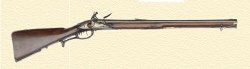 |
A Princely Jaeger by J.G.Dachtine |
|---|
Pistols
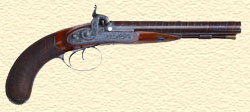 |
A fine double-barreled percussion Howdah pistol (or perhaps a carriage pistol) by James Purdey. |
|---|---|
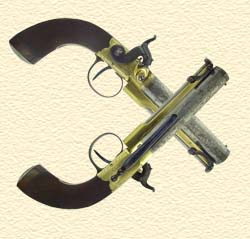 |
A brace of fine boot (or belt) pistols by Benjamin Cogswell. |
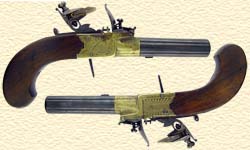 |
The Muff Pistol |
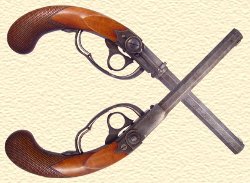 |
Danish Kammerlader Pistols |
Miscellaneous
References
British Gunmakers: Index, Appendices and Additional London, Birmingham,
Regional and Scottish Records
by Nigel Brown
This excellent reference gives detailed histories of the London school of gunmaking from John Manton to the
present. All of the major gunmakers, their biographies, places of work and where available, records of the
serial numbers of their guns. This book is both a fascinating read and an invaluable reference.
Deane's Manual of the History and Science of Firearms by John Deane
Written in 1858 at the end of the muzzleloading era, this book gives a good historical survey of arms, from
the crossbow to early breechloading designs. There is a wealth of material for early military arms and
artillery enthusiasts, as well as commercial information about the makers of that period.
Read it for FREE at Google Books
Eprouvettes by RTW Kempers
Subtitled "A Comprehensive Study of Early Devices for the Testing of Gunpowder", it is indeed that.
It is extensively illustrated and covers the art and science of gunpowder testing from medieval times to he
modern age, including some of the author's own experiments.
The Gun and Its Development
by William Greener
This is the BIBLE for early firearms. It is an exhaustive source for all early firearms information, including
descriptions of early firearms development, barrel forging, lock making and all aspects of the firearms
industry in the mid 19th Century. Every muzzleloading enthusiast should have a copy of this book.
Other FREE books from Greener are:
The Science of
Gunnery
The Breechloader and How To
Use It
The Gun, or a Treatise on...
Small Fire Arms
Instructions to Young
Sportsmen by Ltc. P. Hawker
This is the one book every muzzleloading enthusiast must own. First published in 1814 and reprinted in many
different editions until the present, this book details the transition from the late flint period through the
development of percussion (detonating) guns. Filled with descriptions and anecdotes of life in the early 18th
century, it describes everything from making and maintaining guns to hunting and cooking game - not to mention
how to cure your sick dog.
Read it for FREE at Google books"
The Mantons:
Gunmakers by W. Keith Neil and D.H.L. Back
Published in 1967, this is the definitive book about the Manton brothers, showing details of the various types
of guns they made, patents, serial number lists and sales records. Anyone seriously interested in Manton guns
needs to have this book. A second volume, The Manton Supplement,
published in 1978, gives additional information which surfaced since their first publication.
The
Mortimer Gunmakers 1753-1932 by H. Lee Munson
A treasure trove of information on the Mortimers. There are copious photographs and illustrations, although I
wish they were of higher quality. Another indespensible reference for anyone interested in the London school
of gunmaking.
Pistols, History, Technology, and Models from 1550 to 1913 by Adriano Sala
A beautifully illustrated book with a surprising amount of information about transitional and unusual pistols.
There are also excellent drawings describing the various lock mechanisms.
Purdey, The
Definitive History by Donald Dallas
Gorgeously illustrated and detailed book covering the Purdey "Gun and Rifle Makers" from 1816 to the
present. The photographs alone are worth the price of this book.
The Scottish Pistol Its History, Manufacture and Design by Martin Kelvin
A fascinating history of arms and society in Scotland. Very well illustrated, complete with makers names and
many historical references. It is worthwhile owning this book even if you don't have a Scottish pistol,
and it is essential if you plan to buy one.
Shooting Simplified by J.D.Dougall
Shooting lots of things - in Scotland...
Read it for FREE at Google Books